Cumulative injustice
Exposure to unjust policing across the life course
University of Manchester
London School of Economics
University of Pennsylvania
Teachable moments as static encounters
Most criminological research on procedural justice
- Treats encounters as isolated moments
- Police-citizen encounters
- Police stops
- Highly publicized incidents
“Each of these police-citizen contacts is potentially a ‘teachable moment’ about policing for both citizens and police” (Tyler, Fagan, and Geller 2014, 752)
Teachable moments as dynamic exposures
Encounters are not evaluated on a blank slate
\(\leadsto\) Experiences with law enforcement accumulate over time
\(\leadsto\) Encounters are embedded within broader trajectories of repeated experiences and neighbourhood socialisation
Theoretical insights from criminological theory
Life-course theory of cumulative disadvantage
“The idea of cumulative disadvantage draws on a dynamic conceptualization of social control over the life course, integrated with the one theoretical perspective in criminology that is inherently developmental in nature—labeling theory” (Sampson and Laub 1997, 1–3)
A developmental theory focused on dynamic processes
Cumulative disadvantage mechanism
Identity-based mechanisms, turning points, and redirected trajectories
Legal cynicism theory
“Legal cynicism refers to a cultural orientation in which the law and the agents of its enforcement, such as the police and courts, are viewed as illegitimate, unresponsive, and ill equipped to ensure public safety” (Kirk and Papachristos 2011, 1191)
Builds on the life-course theory of cumulative disadvantage (Sampson and Laub 1997)
Neighborhood socialization: police officers are there to protect others against us
Labeling mechanism: individuals labeled as others and excluded from the body politic
Our proposal
A developmental model of repeated teachable moments
Reframe experiences with unjust policing as cumulative, developmental, and contextual
Each individual event remains a teachable moment, but they are embedded within trajectories of exposure across the life course
- Direct exposures
- Network exposures
- Neighborhood exposures
- Intergenerational experiences
Cumulative injustice
Encounters communicate inclusion or exclusion — but we need to situate those signals within the temporal, cultural, and structural contexts in which they are lived
“I was eight when I first got stopped. (…) Thirteen, fourteen, that’s when I get stopped at least three times a week” (Haldipur 2018, 43)
Accumulated experiences of unjust policing across the life course
\(\Rightarrow\) socialization context of cumulative injustice
Some empirical evidence
Some empirical evidence
Average developmental trajectory of legal cynicism in the UK1
Some empirical evidence
Effects of the number of police stops in adolescence on developmental trajectories of legal cynicism
Some empirical evidence
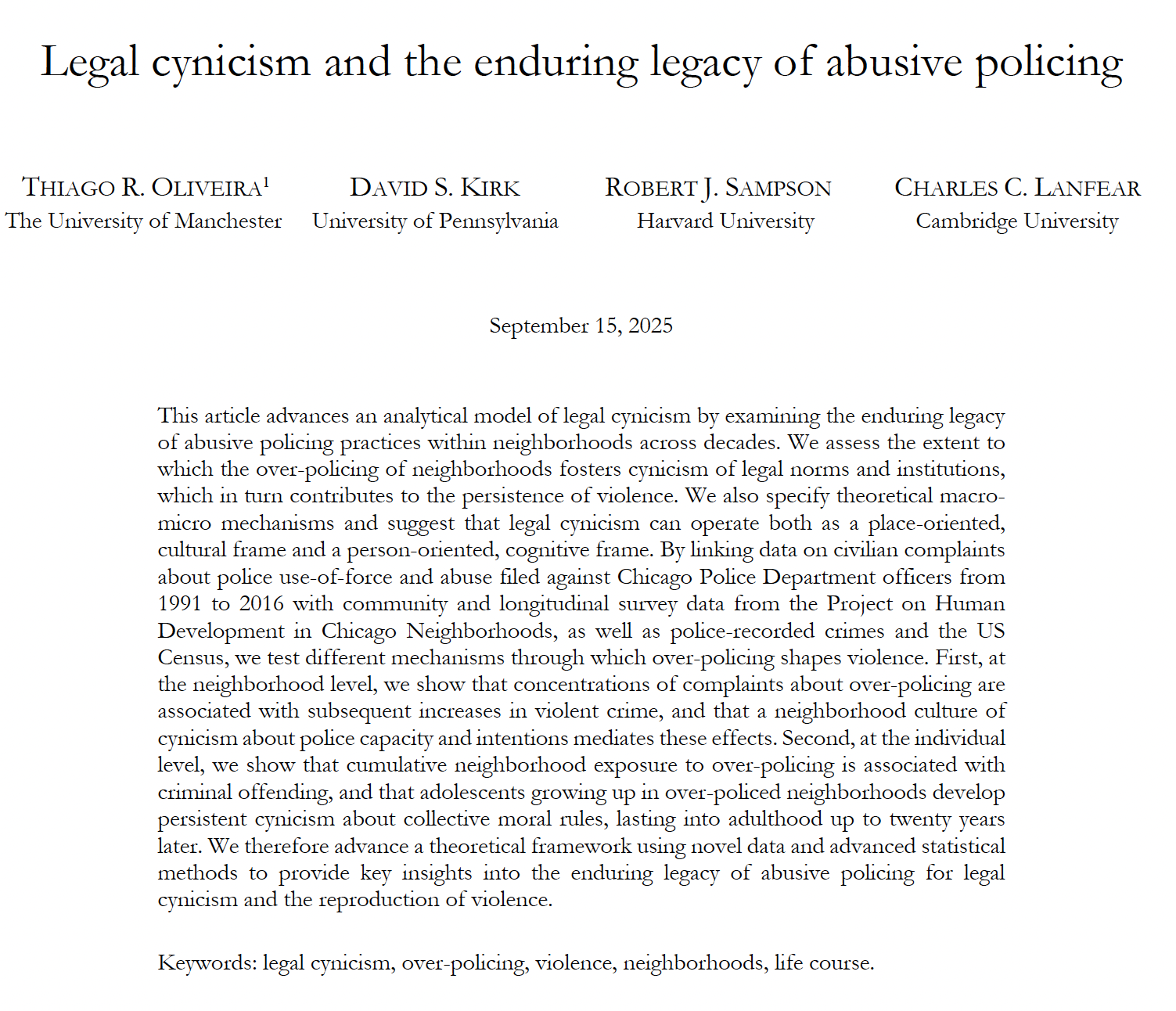
\(\leadsto\) Cumulative neighbourhood exposure to abusive policing during adolescence
\(\leadsto\) Persistent legal cynicism in adulthood
Concluding remarks
From isolated encounters to cumulative trajectories
Cumulative injustice: A research agenda focused on cumulative exposures to unjust policing across the life course
- Dose–response
- Timing
- Trajectories
\(\leadsto\) A life-course approach to procedural justice theory
Thank you!
Data
British Cohort Study
- Following the lives of 17,000 people born in the UK in 1970
- 12 sweeps of data collection, from infancy to age 46
Measures
- Any experiences of police stops between ages 10 and 16
- Number of experiences of police stops followed by a warning between ages 10 and 16
- Legal cynicism measured at ages 16, 26, 30, and 34
Analytic strategy
Growth curve model
- Developmental trajectories of legal cynicism from age 16 through 34
- Influence of the number of police stops followed by a warning between ages 10 and 16 on those developmental trajectories
- Effects on the initial state of the trajectories
- Effects on the shape of the trajectories
Analytic strategy
- Binary outcome: Legal cynicism at ages 16, 26, 30, 34
- Time specification: age and age squared (quadratic growth curve)
- Main explanatory variable: number of police stops followed by a warning between ages 10 and 16 (square rooted)
- Covariates:
- demographics (sex, ethnicity, socioeconomic status)
- psycho-social confounders at age 10 (impulsivity, aggressiveness, learning scores)
- behavioural confounders at age 10 (bullying behaviour, violent behaviour)
\(\leadsto\) Multilevel growth curve model specified with a logistic function link and interaction terms
References