American Society of Criminology Annual Meeting 2026
University of Manchester
University of Pennsylvania
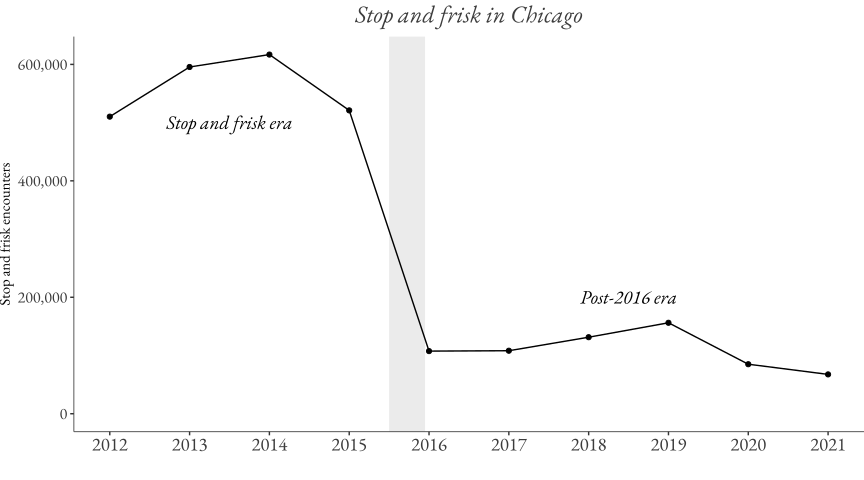
“In 2014, Chicago police stopped, questioned, and often frisked more than 718,000 people. That was a big number for a city of 2.7 million. It was more than three times the stop rate in the place best known for its aggressive stop & frisk policy, New York City” (Skogan 2022, 1)
“(…) during its peak year of 2014, 90 percent of those stopped were African Americans and Hispanics. From 2013 to 2015 more police enforcement actions were taken in Chicago’s predominately African American neighborhoods than there were people living there, every year” (Skogan 2022, 2)
“This process I refer to as the overpolicing-underpolicing paradox. Policing seemed to be a ubiquitous part of the lives of many of these marginalized young people; however, the law was rarely there to protect them when they encountered victimization.” (Rios 2011, 54)
“One indicator that poor African Americans in particular have been excluded from police resources is that police repeatedly fail to respond, or to respond in a timely fashion, when they are called. (…). In response to police abandonment, marginalized people seeking protection or redress of grievances have generally turned to ‘self-help.’” (Bell 2017, 2116)
\(\leadsto\) …for the persistent neighborhood concentration of over- and under-policing?
\(\leadsto\) …for self-help behavior among residents of those neighborhoods, several years later?
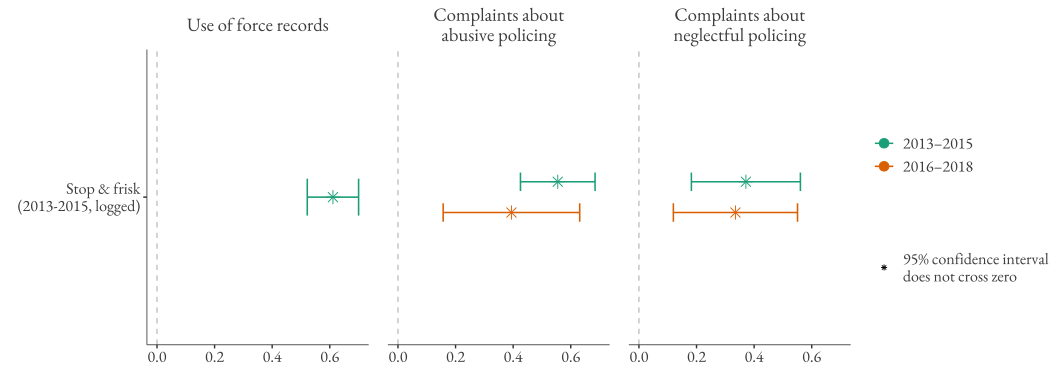
Neighborhood-level data (\(N=865\) census tracts)
Main independent variable
Counts of contact cards recorded by the CPD
Main dependent variables
Counts of Tactical Respose Records (TRR) recorded by the CPD
Counts of CPD complaints in which allegations were: “use of force”, “excessive force”, “verbal abuse”, “illegal search”, or “false arrest”
Counts of CPD complaints in which the allegations were: “neglect of duty”, “inadequate / failure to provide service”, or “slow / no response”
Main control variables
\(\leadsto\) Police-related variables
Includes previous records of homicides, robberies, and aggravated assault recorded by the CPD
\(\leadsto\) Structural antecedents (US Census 2010)
5x Poisson SLX models (Conley SEs) controlling for concentrated disadvantage, residential stability, immigrant concentration, population density, and spatial lags. \(N=846\). (Linear SLX models with
log(y+1)andasinh(y)outcomes yield substantively identical results).
Project on Human Development in Chicago Neighborhoods (PHDCN)
287 PHDCN+ respondents were living in Chicago from 2012 to 2015, the era of stop & frisk (Skogan 2022)
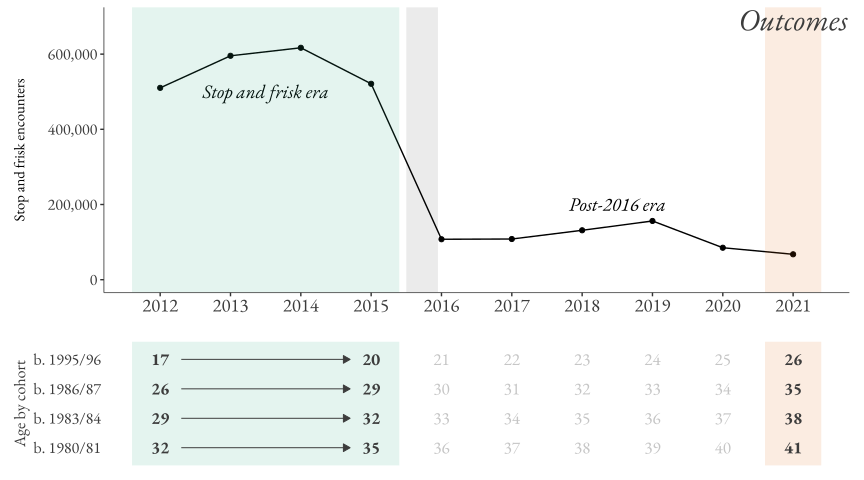
Independent variable: Cumulative neighborhood exposure to stop and frisk (2012–2015)
We define \(D_{ijt}\) where \(T \in \{1, 2, 3, 4\}\) as the number of stop and frisk encounters in neighborhood \(j\) where respondent \(i\) was residing during period \(t\). Periods here refer to years 2012 (\(t=1\)) through 2015 (\(t=5\)). We then define cumulative neighborhood exposure to stop and frisk as \(cum(D_{i})= \sum_{t=1}^{4}d_{ijt}\), i.e., the sum of all SQFs per individual across this four-year period
Dependent variable: Gun carrying in adulthood (2021)
Have you ever carried a concealed or hidden gun with you anywhere?
1: Yes, in the last 12 months
0: No, not in the last 12 months
Neighborhood exposure to violent crime is a time-varying confounder, as SQFs and violent crime are dynamically related. Weights created using residual balancing permits appropriatelly controlling for time-varying confounders without introducing over-control bias.
Other (pre-exposure) controls:
The Child Behavior Checklist (CBCL) survey instrument was a parent-report questionnaire on which the child was rated on various behavioral and emotional problems.
\(\leadsto\) Effects disaggregated by race: White, Black, Hispanic
Probability of gun carrying in adulthood
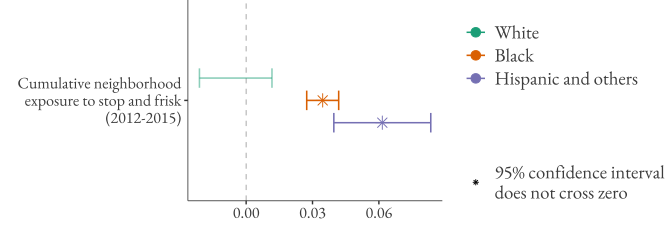
Marginal structural models estimated as Firth’s penalized linear probability models with weights created using residual balancing to control for dynamic exposure to neighborhood violence and robust Huber-White standard errors. \(N=257\).

In Chicago, aggressive policing tactics were widely used between 2012 and 2015 – the stop & frisk era (Skogan 2022)
“Confrontational proactive policing methods may have social benefits in crime reduction but costs in intrusion on the rights and privacy of innocent persons” (Manski and Nagin 2017, 9308)
\(\leadsto\) These associations persist even after the end of the stop & frisk era
“I see cops so often in my neighborhood, but when I see something bad going on, I look around and say ’where are the cops?” (18-year-old girl from Phildelphia interviewed by Carr, Napolitano, and Keating 2007, 458–59)
\(\leadsto\) Implications of the “overpolicing-underpolicing paradox” for gun-carrying behavior, even years later
“(…) there are thee Chicagos, not one. The city’s large White, African American, and Hispanic neighborhoods differ dramatically in character, including their distinctive crime problems and their relationship with the police. In important ways residents live in different worlds” (Skogan 2022, 18)
\(\leadsto\) Not for White residents